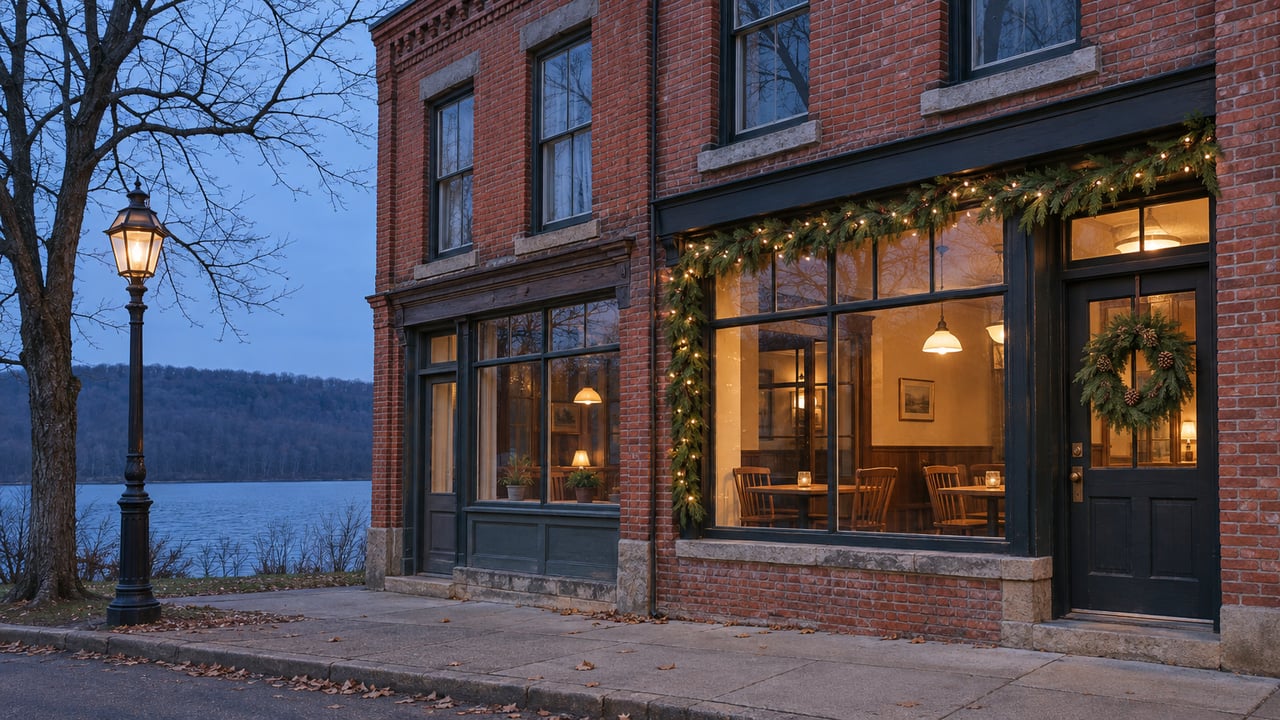
At 107 Lake Street there's now a playground, a pavilion, a dock with a waterfront landing, and an accessible path that leads back toward downtown. The sign at the entrance was made by Sam Castner of Ironvine Studios. At the formal opening on May 27, 2026, one guest was a direct descendant of the Walker family, as the Chronicle-Express reported.
That guest list explains the name. According to the New York Department of State, the Walkerbilt Company "began as a local sawmill in the late 1800s at the site of the park." So the new park sits on old ground. It's the first time in decades that the public can use a stretch of Lake Street that was industrial for most of a century, and the streets around it still show how the factory was laid out.
A Name That Won by a Narrow Margin
The project was called the Lake Street Park improvement until January 2026. That month the Village Board reviewed the results of a public naming survey. FingerLakes1 reported that "Walkerbilt" got the most support, narrowly ahead of "Pudgie's Park." The same meeting noted that the project had already won the American Public Works Association's Project of the Year Award in the Structures category for small cities and rural communities.
The board expected an early March opening back then. The formal ribbon-cutting came on May 27, when Secretary of State Walter T. Mosley came to Penn Yan to mark the end of a $1.8 million project paid for through the village's Downtown Revitalization Initiative. Fisher Associates handled design, City Hill Construction was the prime contractor, and the Village Department of Public Works also worked on the project.
The name was chosen by vote, so it was deliberate. To see what the vote preserved, you have to go back about 150 years.
From Sawmill to Store Fixtures Shipped Across the Country
The Yates County History Center keeps a transcription of an undated Walkerbilt company pamphlet. The History Center thinks it was written in the early to mid 1950s. It's the most detailed account of the business that exists, and it lays out the timeline below.
- About 1870. A sawmill and lumberyard opens and gradually adds woodworking machines.
- About 1890. W.M. Patterson buys the business.
- About 1900. Patterson teams up with E.J. Walker, a Philadelphia merchant who had patented a self-counterbalancing pivoted bin. Together they run the Walker Bin Company in Penn Yan.
- December 1933. Packaged goods have replaced bulk bins, the Depression has hit, and the Walker Bin Company closes.
- March 1934. Four men restart the business under the name Walkerbilt.
- 1974 and 1979. Haywood Wakefield buys the company, then sells it to Pennsylvania House, which eventually moves all operations out of Penn Yan.
The bin was the product that made the company. Before it, the pamphlet says, most foods, seeds, grains and feeds sat in barrels or bags that drew vermin. The counterbalanced bin was built into counters and shelving, so it was easy to open, close and pour from. Walker bins went into thousands of stores across the country and in several other countries, and the pamphlet says Penn Yan workmen traveled as far as England to install them.
The comeback after 1934 was built on whatever work came in. The revived Walkerbilt made woodwork for new central schools around Upstate New York, took on wartime wood production during World War II, and by the 1950s ran a building materials dealership alongside four separate manufacturing lines.
"Stromberg-Carlson Company of Rochester, New York buys four of its models from Walkerbilt. the unassembled wood parts are made in the Lake Street Plant and then taken across town to the Champlin Avenue Assembly and Finishing Plant."
The pamphlet says the cabinets were assembled, stained, lacquered and oil-rubbed at that second plant, then inspected, packed and trucked to Rochester. There Stromberg-Carlson added radios, phonographs and in some cases television units. The company also made tables for tailors' pressing machines and custom pieces from special windows to a mahogany bookcase. It ran a building materials business that stocked ten to twelve thousand items for builders across Yates County.
The Factory Map Under Today's Streets
The pamphlet also describes where everything stood, and those street names will sound familiar to anyone who drives through the village. The table below matches each piece of the operation to the street the pamphlet gives for it.
| Walkerbilt operation, per the 1950s pamphlet | Street |
|---|---|
| Large warehouse, display area and building materials offices | Lake Street |
| Six large sheds and four acres of lumber, shingle, brick and cement storage | Commercial Avenue, "across the street" |
| General, executive and factory offices, including the drafting room | The Main Street end of the main building |
| Radio cabinet assembly and finishing plant | Champlin Avenue, "across town" |
The whole operation added up to six working buildings, ten storage buildings, roughly 300 woodworking machines, and about 180 employees. The pamphlet counts about 150 men and 30 women. In the 1950s, Lake Street and the blocks around it were a working industrial district that ran from Main Street to the lumber sheds.
That history matters right now, too. Commercial Avenue, where the lumber was once stacked in the open to dry in the wind and sun, is one of three streets the Village started repaving on October 6. North Avenue and Kimball Avenue are the other two. They're closed to through traffic with local traffic allowed, and the work was expected to take a couple of weeks, weather permitting.
What the Old Industrial Block Connects to Now
The state's description of the park focuses on connections. The accessible paths link to downtown. Steve Griffin of the Finger Lakes Economic Development Center said the project "strengthens the connection between downtown Penn Yan and Keuka Lake." For the opening ceremony, the state media advisory sent visitors from the Village Boat Launch to the park on a short walk along the outlet trail.
That makes the park a link in a chain of waterfront stops along Water and Lake Streets. The Village parks page lists them.
- Penn Yan Boat Launch & Park, 290–298 Water Street
- Walkerbilt Park, 107 Lake Street
- Red Jacket Park, 309 Lake Street
The Village has also formed a Finger Lakes Tourism Building Committee to look at a possible gift of the building at Red Jacket Park and what it could be used for, along with possible upgrades.
The longer walk heads in the other direction. The Keuka Outlet Trail runs seven wooded miles from Penn Yan to Dresden and is open for walking, biking, horseback riding and cross-country skiing. It's maintained by Friends of the Outlet, a nonprofit. In January, the Village Board gave the group permission to put a swing bench along the trail near the Seneca Street trailhead.
Walkerbilt is one of several DRI projects that rebuilt the old commercial blocks around the park. One example is the 1820 Laurentide Inn at 158 Main Street, where the carriage house and stables became a brewery and taproom. The inn lists Laurentide Beer Company & Kitchen as open most days from 3 to 9 p.m., opening at noon on weekends. The same state program funds the Sampson Theater renovation at 130 East Elm Street, the Struble's Arcade mixed-use project, and streetscape work along Water and Wagener Streets. The state's May announcement describes what each project covers but gives no completion dates.
Using the Park This Fall, and Booking It for Next Year
The pavilion can be rented for events. The Village charges $50 for village residents and $100 for non-residents, and reservations for each year open in early April. The Village website doesn't list park hours or a seasonal closing date. The boat launch on Water Street does not allow overnight parking.
If you're driving to the park this fall, plan around a few other projects on the village calendar.
- North Main Street has been closed to everything but local traffic since September 14 for infrastructure work and paving, with completion estimated by mid-November. The work includes a $701,500 water-main contract awarded to Nardozzi Paving & Construction.
- Brush pickup for the Village's Fall Cleanup starts October 19, so brush needs to be at the curb by October 18.
- Leaf pickup runs November 16 through December 4, with leaves at the curb by November 15. The Village asks for no plastic bags, and free paper bags are available at Village Hall, 111 Elm Street.
The Walker Bin Company closed in December 1933. Ninety-two years later, in January 2026, the village voted to put the Walkerbilt name back on Lake Street.
If you own a home near Keuka's north end and want to talk about how projects like Walkerbilt Park, the outlet trail, and the downtown rebuild affect daily life around the water, Mary is glad to talk it through by phone. Call Mary St.George (REAL Broker Finger Lakes) for a Lakefront Consultation.